Faith, Mental Health, and Leadership Under Pressure
Faith, Mental Health, and Leadership Under Pressure
When clarity is thin, pressure is high, and the mind needs more than strategy
“God is not a God of confusion but of peace.” — 1 Corinthians 14:33
There is a kind of leadership exhaustion that doesn’t always announce itself clearly. It doesn’t always look like burnout. Often, it looks like functioning. The meetings still happen. The decisions still get made. The responsibilities still get carried.
But underneath it, something quieter is happening.
A sense of pressure without pause. Responsibility without relief. Clarity that feels harder to access than it used to be. And over time, even the most capable leaders begin to notice it: Not just stress. But a kind of mental and emotional overload where thinking feels heavier than it should.
This is where leadership, neuroscience, and biblical wisdom begin to speak the same language.
When pressure affects the mind
From a neuroscience perspective, sustained pressure changes how the brain operates.
The prefrontal cortex—the part of the brain responsible for:
decision-making
emotional regulation
planning and perspective
complex problem-solving
begins to work under reduced capacity when stress is prolonged. At the same time, the brain’s threat-detection system becomes more active.
This creates a predictable experience:
narrowing of options
faster emotional reactivity
reduced cognitive flexibility
difficulty holding long-term perspective
This is not weakness. It is biology under strain.
The brain is doing exactly what it is designed to do:
prioritize survival over expansion when everything feels uncertain.
And this is where Scripture offers something deeply grounding.

Peace as a leadership and neurological state
When Scripture says:
“God is not a God of confusion but of peace” (1 Corinthians 14:33),
it is not just describing a spiritual truth. It is describing an internal state of order, clarity, and coherence.
In modern terms, we might describe this as:
reduced cognitive fragmentation
increased emotional regulation
restored capacity for discernment
clarity under complexity
Peace, biblically understood, is not the absence of challenge. It is the presence of alignment within the mind and spirit even in the presence of pressure. And that alignment matters deeply for mental health in leadership. Because the brain cannot think clearly in sustained confusion or overload.
Faith as a stabilizing force for the mind
In leadership, faith is often treated as separate from performance or mental health. But in lived experience, and in how the brain actually functions, faith plays a stabilizing role.
Faith is the ability to hold meaning when clarity is incomplete.
It allows the mind to say:
“I may not see the full picture yet, but I am not without direction.”
And meaning matters neurologically.
When the brain experiences meaning:
stress becomes more tolerable
attention becomes more stable
emotional reactivity decreases
future-oriented thinking returns
Meaning does not remove pressure. It reframes it. And that reframing is essential for mental health under leadership demands.
Hope as a God-given cognitive pattern
Hope is not simply optimism or positive thinking. Hope is structured thinking under uncertainty.
It is built on three core components:
Vision (Goals): What are we moving toward?
Wisdom (Pathways): What are the possible ways forward?
Stewardship (Agency): What actions can I take that matter?
When these are present, the brain begins to re-engage:
motivation systems activate
problem-solving returns
cognitive flexibility increases
emotional regulation improves
In biblical language, hope is not wishful thinking. It is anchored expectation shaped by trust and direction. In leadership language, hope is the capacity to think forward under pressure.
Mental health in leadership is also system health
One of the most important truths in both neuroscience and organizational leadership is this:
Mental strain is not only individual; it is environmental.
When systems are:
unclear
constantly changing
high-pressure without recovery
disconnected from meaning
lacking feedback and reinforcement
the nervous system adapts accordingly.
Over time, even high-capacity leaders begin to experience:
emotional fatigue
reduced clarity
slower decision-making
decreased sense of agency
This is not a failure of resilience. It is the impact of sustained cognitive load without sufficient restoration.
Biblical wisdom and modern neuroscience agree on one thing: clarity restores the mind
Across both Scripture and neuroscience, a consistent principle emerges:
Clarity restores what confusion depletes.
Biblically:
Peace replaces confusion
Wisdom brings direction
Faith steadies the heart
Neuroscientifically:
clarity reduces cognitive load
reduced load restores prefrontal function
restored function improves decision-making
In both frameworks, the outcome is the same:
A mind that can think again.
A leader who can see again.
A system that can breathe again.
What I’ve seen in leadership systems
I’ve worked with leadership teams where nothing looked “broken” on the surface.
But underneath, something had shifted:
People were still showing up—but with less openness.
Still executing—but with less clarity.
Still committed—but with more internal strain.
When we began to intentionally restore three things:
clarity (what is true and what matters now)
hope (what is still possible and what steps exist)
faith (why this work still carries meaning and purpose)
something changed. Not instantly. But steadily.
Conversations became clearer. Emotional tension decreased. Decision-making improved.
And leaders began to feel less internally fragmented. Not because the pressure disappeared. But because the mind was no longer carrying it alone.
Leadership that sustains mental health is leadership that restores peace
Leadership is not just about outcomes. It is about the internal environment people are operating in while producing those outcomes.
When confusion is high, the mind contracts. When clarity is present, the mind expands.
When hope is active, the mind moves forward. When faith is anchored, the mind stays steady under uncertainty.
And when those three are present together:
People do not just perform.
They endure with clarity.
They lead with steadiness.
They think with wisdom under pressure.
Closing: leadership as the stewardship of clarity and peace
If there is a grounding truth in both Scripture and neuroscience, it is this:
The mind was not designed to live in sustained confusion.
It was designed for clarity, meaning, and peace. And leadership plays a significant role in shaping whether those conditions exist. Faith anchors meaning. Hope creates pathways. Peace restores clarity.
And together, they create the conditions where both leadership and mental health can be sustained... not just survived.
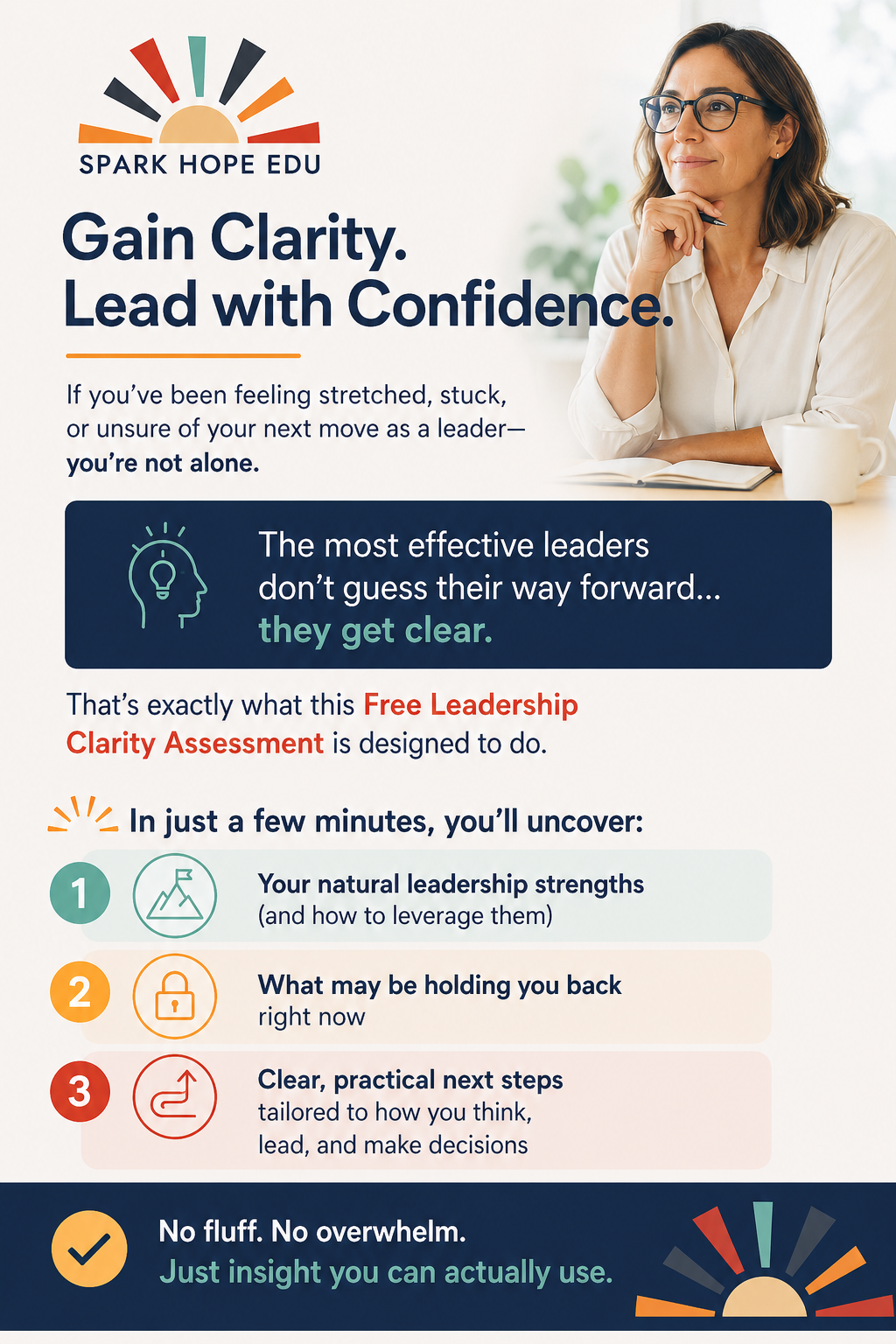
Take the next step
If you are navigating complexity, pressure, or uncertainty in your leadership, and want to understand where clarity, agency, and resilience are being strengthened or unintentionally strained...
👉 Take the Leadership Clarity Assessment
It will help you identify where your leadership system is supporting mental clarity and hope and where it may be contributing to cognitive overload or emotional fatigue.